CADASIL Research Studies & Clinical Trials
Your participation directly advances our understanding of CADASIL and brings us closer to a cure. Find ongoing studies and learn how to get involved.
CADASIL is a rare disease that has only been identified within the past few decades. As such, there is still significant research to be done to fully understand its pathology, progression, and other distinct aspects.
This research requires willing participants from within the community of CADASIL patients. Below, you can find links to ongoing CADASIL research studies or clinical trials, including information on how your involvement can help us get closer to developing new treatments and eventually a cure.
If your organization or university will be starting a new CADASIL-related research project in the near future, contact us at info@cureCADASIL.org.
We are not aware of CADASIL clinical trials that are currently seeking participants to test treatments (see Active Studies).
Drug Development Process
Scientific research is needed before drugs and therapies can be tested in humans.
- Researchers will collect patients' natural history and test results to use with computers/AI, cells, and animal models to identify potential targets for therapies
- Researchers use human cells to test the potential targets and identify which potential therapies can affect the cellular abnormalities found in CADASIL
Read about Clinical Research →
NIH's Definition of a Clinical Trial →
Phases of Clinical Trials →
Clinical trials involve people who volunteer to test and help find better treatments.
- Clinical Trial Phases I–III will test drug and therapy safety and efficacy in humans
- If a therapy is proven safe and effective, it can be approved by the FDA and become available for use in clinical practice
- After the therapy enters clinical practice, post-market monitoring begins
Once the disease has been studied, clinical trials have been conducted, and a therapy has been proven safe and effective, we are on our way to treating and curing CADASIL!
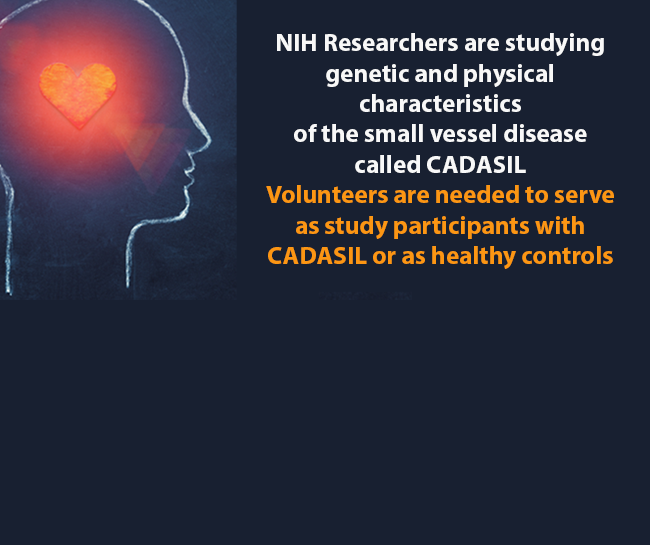
Studies to Join Now
Additional Programs & Resources
cureCADASIL is collaborating with members of the Clinical Genome Resource (ClinGen) team to share genetic and health information from patients affected by CADASIL through the ClinGen Patient Data Sharing Program. This information will be collected through the cureCADASIL Family Registry.
Why is data sharing needed?
When a laboratory finds a genetic change (variant) for the first time, often little is known about it. Even if a genetic variant is well understood, data sharing helps increase understanding of a condition's features, which may help identify possible interventions and treatments.
Note: cureCADASIL previously collaborated with the Clinical Genome Resource (ClinGen) team to share de-identified genetic and health information from CADASIL patients through the ClinGen Patient Data Sharing Program. This program helped identify novel CADASIL variants and advance genomic understanding of the disease.
CADASIL Community Natural History Study — Learn more about this important cureCADASIL-supported study tracking disease progression to inform future clinical trials.
cureCADASIL is aware of three CADASIL Tissue Banks in the US supported by brain and tissue donations by surviving families of CADASIL patients. For researchers interested in CADASIL tissue for research, please contact cureCADASIL. For patients or families interested in donating a loved one's brain or tissue for CADASIL research please contact one of the following:
Michael M. Wang M.D., Ph.D.
University of Michigan, Department of Neurology
VA Ann Arbor Healthcare System, Ann Arbor, MI 48109
Phone: 734-845-5202 | Email: micwang@umich.edu
Helmi L. Lutsep, M.D.
Oregon Health & Science University, Department of Neurology
VA Portland Health Care System, Portland, OR 97239
Phone: 503-494-7225 | Email: lutseph@ohsu.edu